

The first thing many of you ask when I share a new project is…Can I sew it with knits?
Yes! Yes!
The answer is (most likely) YES!

So if you bought the First Day Dress and Top Pattern, and would like to sew it with knit fabrics, then let’s do it!
And let’s do it with Gleeful Fabrics from Sew Caroline and Art Gallery Fabrics!
I’m so happy I get to be part of Caroline’s blog hop, showing off her new fabric line….because not only does it come in gorgeous woven cottons, but a few of the prints come in KNITS! And when this pretty package showed up in the mail, I thought…..
First Day Dress…..


And how about a dress that’s FULLY reversible! So it fits your every mood?


YES!

Okay, let’s get started.
We’re making a peplum Top.

This tutorial is based on the First Day Dress Pattern which you can purchase here and read extra details here.
You don’t need to use knit fabrics to make the dress or top fully reversible. But it sure makes it cozy and soft, and gives you even more fabrics options to work with.
If you’ve sewn the dress or shirt before then you know that the style is pretty much reversible already. But to really make it work on both sides, you need to sew a matched hem (page 20 in the pattern), and you need to consider your back closure: either a button or a tie.

The pattern calls for a button and elastic, which works well on one side of the fabric. However, when you reverse the shirt you end up with a button on the inside, touching the body. Now if the button is flat enough, you could sew one on each side of the shirt and call it good.
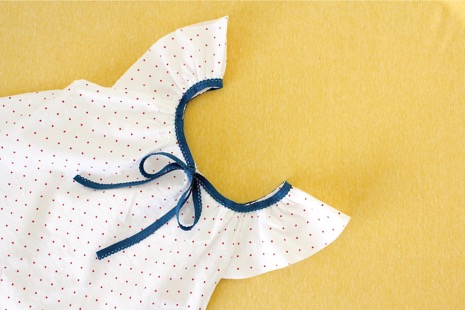
But….if you sew a tie on each side of the back slit, it makes the shirt fully reversible and looks adorable with that little bow in the back. Hooray!

So grab two different knit fabrics. for your Outer and Lining layers and lets start cutting.
I’m using a polka dot fabric purchased from Michael Levine, and the yellow Sun Springs print from the Gleeful Line by Sew Caroline.
Now let me just say how fantastic these Gleeful knits are. The fabric washes beautifully (and will shrink a bit, as is expected of all cotton knits—so always remember to pre-wash before sewing!) It’s more of a lightweight knit and it sews beautifully. I found myself hoarding leftover scraps for future projects. The fabric would work wonderfully for a pair of leggings, a baby blanket, basic Tee, KID shorts, or check out Delia’s jammies she made using the same fabric. Darling!
When it comes to cutting and sewing with knits, just follow the same instructions as outlined in the pattern, laying the pattern piece so the grainline marking runs parallel to the selvage. This ensures that the fabric will stretch horizontally, from side to side, across the shirt.
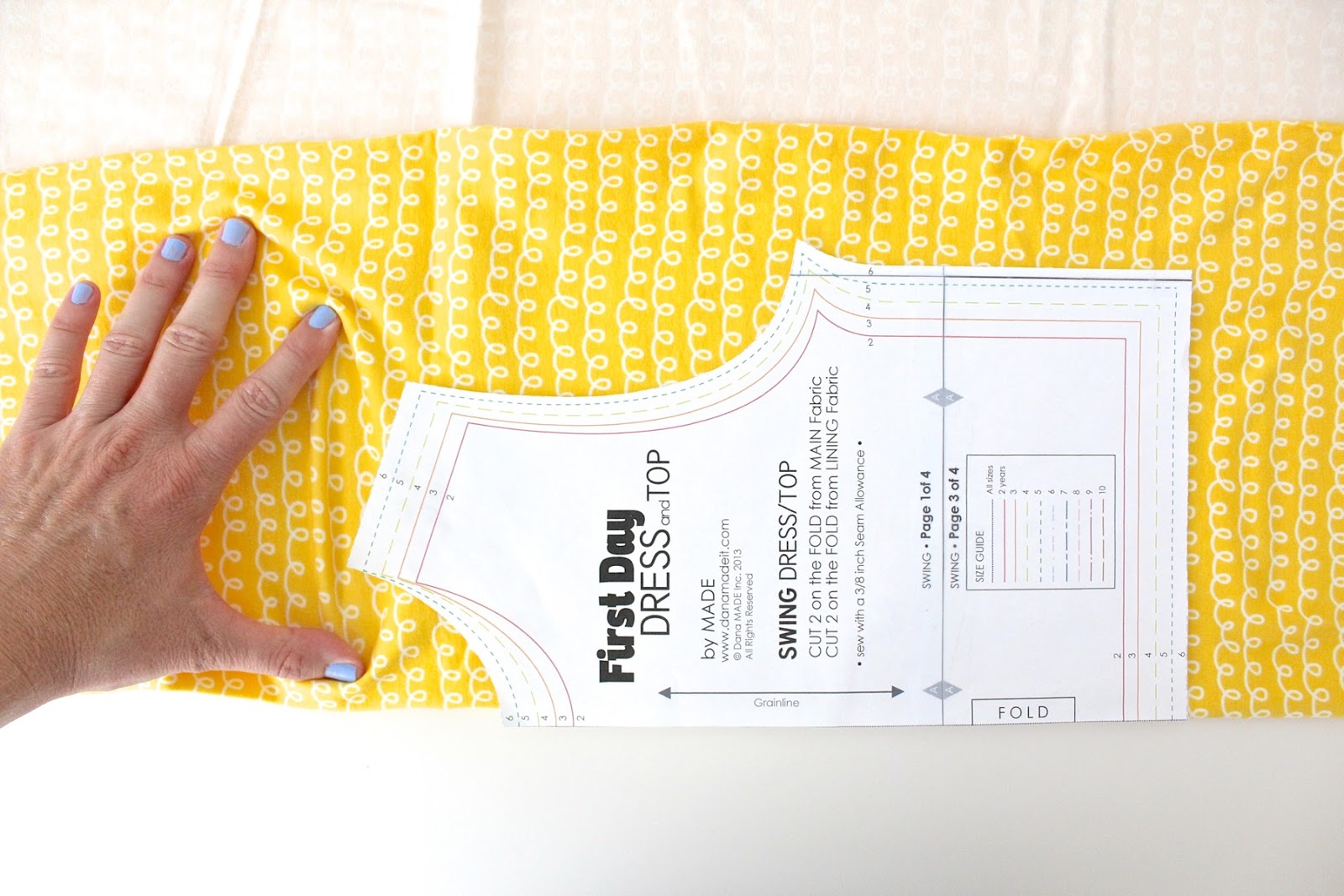
Cut out all your pieces, as outlined in the pattern.
Now let’s talk about Straight stitches vs. Zigzag stitches.
• You could sew (most of) the shirt with a serger, if you have one.
• Or you could sew the shirt with zigzag stitches. A zigzag is a stitch that stretches with your fabric (like the photo of the waist seam below). A straight stitch cannot stretch, and will snap and break, if it’s sewn in the direction that the fabric stretches.
• Or you sew with a combo a zigzag and straight stitches. That’s what I like to do.

A good rule of thumb—
• Use a zigzag stitch for seams that run in the direction of the fabric stretch, and on areas of the garment that will stretch with wear (around the waist, the neckline, the hem of a t-shirt—if it’s a basic Tee style).
• Use a straight stitch for seams that do not stretch with the fabric (shoulders, vertical side seams).

Now these are not hard and fast rules but rather, recommended guidelines.
So, when sewing the First Day Dress (SWING styles) in knit fabrics….
Sew the following seams with these stitches:
Waist seam (bodice to the peplum or skirt) – Zigzag stitch
Shoulders – Straight stitch
Sides – Straight stitch
Neckline and Back Slit – Zigzag around neck and straight stitch around the slit.
Topstitch around neckline – This should be done with a zigzag as well, so the neck can stretch when a head goes inside. However, I opted to NOT add a topstitch because I didn’t want the look of an exposed zigzag stitch. So I just pressed the neckline well with my iron and skipped the topstitch.
Armholes – Straight stitch. These armholes are large enough that they won’t need much stretch, so a straight stitch is fine. And since the armhole stitching is more of topstitch, I prefer the look of a straight stitch here.
Hem – Straight stitch. If you were sewing a basic Tee, you’d want a zigzag, since the hem of shirt often stretches around a waist. But with this particular peplum style, the hem won’t stretch very much, so a straight stitch is great.
When sewing with knits it’s important NOT to stretch the fabric as you go. Try to let the machine feed the fabric for you. It helps to hold on to straight pins (photo below) with your right or left hand to guide the fabric through without it stretching.

Now let’s talk about the back tie.
Instead of using a button and elastic, let’s sew two strings—each about 15 inches long—into the back slit.
You can use all sorts of things for the tie: bias tape, lace, twill tape, fabric, etc.
What I love to use is knit fabric string. There’s no sewing involved and it looks really cute.
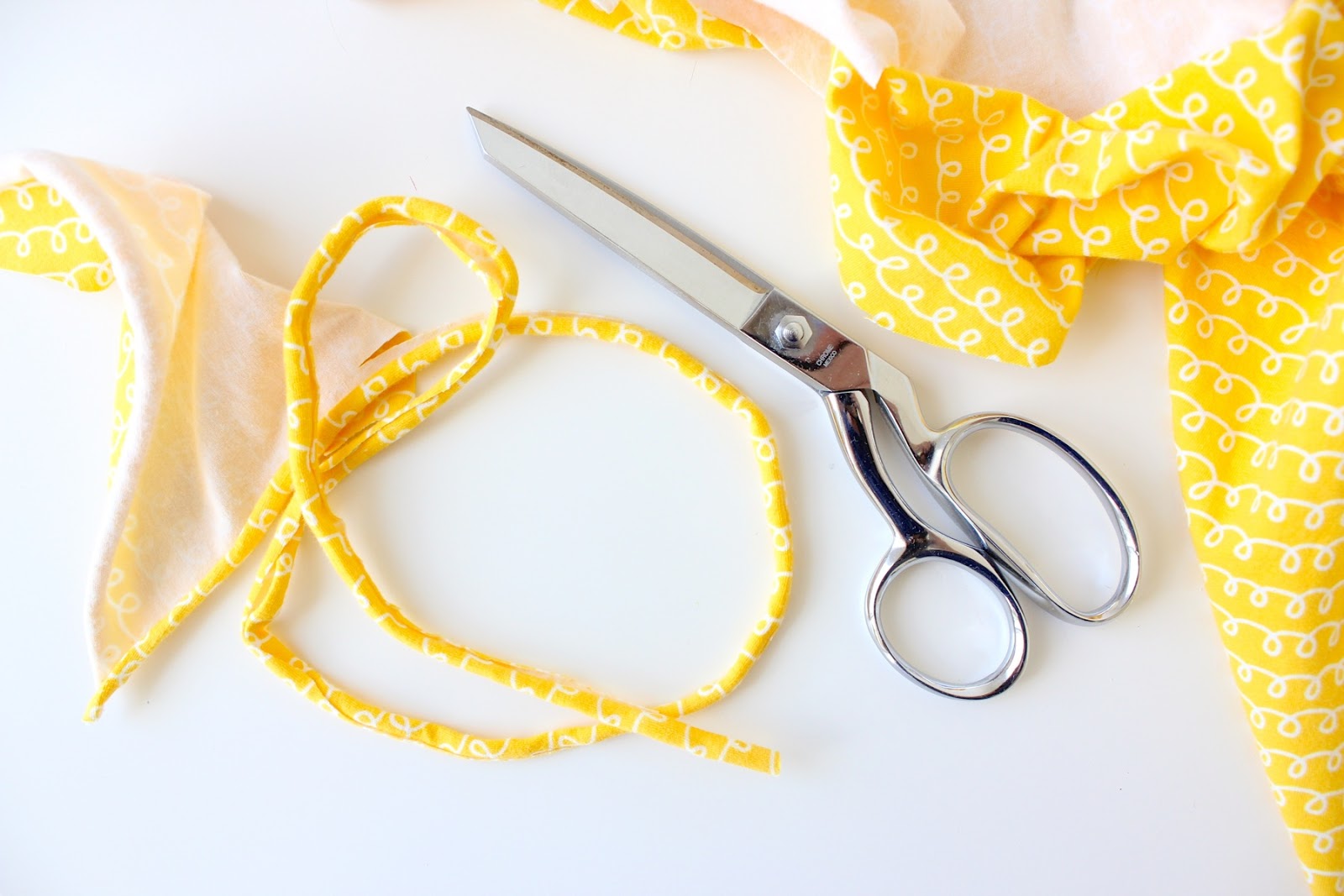
To do this, cut a skinny strip of knit fabric right along the grainline (parallel to the selvage). Then yank and pull the string and the edges will roll up, sort of making a “tube” of fabric. And you have your strings! Easy!

Then insert each string in between the Lining and Outer layers. It’s easiest to go in through the armholes and then to the back slit. Pin and sew each strring in place in the two corners of the back slit. Make sure you leave enough room for the seam allowance at the top of the ncekline (as outlined in the pattern instructions).

Follow the rest of the pattern details for sewing your shirt, and you’re done!

One reversible and STRETCHY top, ready for whatever mood you’re in.


And when it comes to tying the tie in back, here’s another helpful hint to get it to lay flat and in the proper direction….
Whether you’re right-handed or lefty:
• Tie the strings one over the other.
• Then start tying your bow with whichever side of the string is “up” (left photo below)
• If the left side string is higher (or “up”), turn that into a loop first with your left hand (or vice versa if the right side is “up”).
• Then with your right hand, wrap the other string around and pull it through to make the other side of the bow.

I know it seems silly to explain. But it can be frustrating when your bow won’t lay as flat as you’d like.
Now it can!

And that’s all folks.
Happy Sewing!





Lucy and Clara are so cute together. Clara is really getting big. Gosh time goes so fast. Love the knit fabric! I have made one First Day swing dress, and have three more cut out and ready to sew. Now to look for knits in my stash that might work for this, too.
This is so stinking CUTE!!! Thanks, Dana! xoxo
My two favourite dressmakers making magic together… Thanks Caroline for the beautiful fabric & thanks Dana for the amazing First Day pattern & tutorial!
Gah!!! I am such a sucker for matching outfits. Precious, precious. Your girls looks so great, Dana!
GREAT idea! I am definitely going to make one in knit. My kiddos prefer knit 90% anyway, so win win! Thanks for all that great info. 🙂
OH WOW!!!! SO, SEW, CUTE!!! BOTH THE GIRLS AND THE TOPS!!!
I was debating about buying this pattern – but, hello – now I MUST get it!!!
Hopefully this will take my fear away of sewing knits.
Love your blog – have a great day everyone.
I’ve been dreaming up different fabrics for this project! Love seeing the knits you chose!
Can’t wait it see this!
Whoops…. That was meant to say sew (not see!)
They are adorable!!! The tie is a really good idea. Im making one for a bday gift for saturday. I may do the tie. Thanks!
Gorgeous pattern! Love the fabrics you chose. Dana your girls are so cute~^^
I bought the pattern last week, and was also considering a knit project. So glad to see you did one! Totally lovin’ both of those fabrics! You always produce fabulous tutorials, and this one did not disappoint… but I am totally stoked about the demonstration on how to make a dang tie lay flat! I have tied, and untied, and RE-tied bows a ridiculous amount of times attempting to make them lie flat. Who knew the answer was so simple. Love it! Thanks!
So adorable! I bought the pattern last week and am now working on a dress for my granddaughter. Love it!
I don’t think I have commented before. Just wanted to let you know that this patterns is fabulous. The possibilities are endless.
And your little baby is looking so grown up!
This convinced me I need the First Day pattern. I’ve gone to the knit side and never looked back. Thought the pattern was only for wovens until reading this! Hooray!
These turned out SO cute! I love the duo: girls and peplum tops!
Hi Dana, was just wondering if the dress (sleeve version) can be totally reversible as well? Thanks.
So so cute Dana! And I can’t believe how big Clara is getting! She certainly is completely out of the baby stage now and seems to be flying past toddler. And I want to know…did Owen mind being left out of the photo shoot? 🙂 At least we get a peek of him in the sidebar of your blog because he’s on the front of your Kid’s Shorts Pattern. Oh hey! I bet that peplum top is adorable over those shorts!
HI, the kids are growing like crazy. Clara still reminds me of your Owen. Have you considered doing an adult version of the pattern? It is so cute.
Your girls are ADORABLE!!! And I want some of that yellow loopy fabric for a quilt 🙂
Thank you for being willing to share the “simple” details like which seams are straight or zigzag. Truthfully, I wasn’t sure so this was helpful! Adorable pattern, getting very soon!
I always get so inspired when I read your blog! I completely love this!
Great tut thanks.
Those girls are so darn cute! The baby has grown up so fast! Love the little chicklets teeth!
Do you trim the peplum ? When putting mine together it is much more rounded than the picture you show ( the picture with the zig zag circle on it) Also should the peplum be the same width or a little wider then the “top” material ? Thanks !!
I didn’t trim the peplum, but the fabric is just pulled straight for the photo to show the stitch line better.
The peplum and skirt pieces should be the same width as the bodice.
Hi! I’m super excited to make this for my niece so I purchased the pattern this week! I do have a question though and sent you an e-mail I believe this past Wednesday and hoping to hear from you soon so I can get started!
Hi Dana – I’m still waiting on a reply to my e-mail I sent in response to the e-mail you sent in response to my posting. Here’s my e-mail…by the way, I also purchased the KID shorts pattern back in November and have the same issue with the scale:
Hi! Here’s the e-mail with the question:
Hi! I’m printing the FIRST DAY DRESS pattern and having trouble with the scale! First, I had my husband print it on his color printer at work and realized it didn’t print to the correct scale as I measured the double arrows in the upper right hand corner of page 29 of the pattern and saw that it measured 7/8″. Therefore, I printed just one page (to start) and again I printed page 29 and chose the “actual size” option. This time the double arrows still measure 7/8″, however the pattern is definitely a tad larger than the first copy. I’m wondering if you could tell me, on page 29, does size 2 along the bottom measure at 6″? I appreciate your help! I usually don’t have a problem when I have printed patterns in the past and selected the “actual size” option so not sure why I’m having this problem with your patterns and not others 🙁 Thank you!
Hi Liana!
Sorry to keep you waiting. And I’m sorry you’re having printing issues.
To answer your question….
“on page 29, does size 2 along the bottom measure at 6″?”
Yes! It measures 6 inches. And size 4 measures 6 1/2 inches
Does that help??
Aww, you daughters look so much like my nieces, who I live across the country from. These pictures brought a tear to my eye. The dresses are so adorable and your girls are lively and sweet together.:) Blessings.
Hi Dana, I bought your pattern last week and I have just finished making the A-line dress – I did the whole thing reversible – looks unreal! It’s the cutest pattern ever! I could highly recommend it to anyone wanting to give it a go! (I am pretty much a beginner and found it easy to make). I am going to post about it later this week, I’ll link back to your website so hopefully you will get to see the end result – looks unreal! Love Love as always. Px
Sew Sweet!
I’m currently making a knit version for my daughter’s Preschool Graduation on Saturday… I didn’t add the sleeves before sewing down the sides… is it possible to still add them? I’ve just stitched around the neckline and added a button and am about to start the armholes… wish I would have seen the directions earlier.
I’m using a sweater knit, and it’s quite fiddly… so I’m not even sure it’s possible. What do you think??
Cheers!
Adrienne
Hi Adrienne, Sorry I’m not sure without seeing where exactly you are…..You may have to take a seam or two out and add the sleeves in (sometimes that’s easier than trying to make up a creative way to add them). If you have the time, I would try going back to that step. But if you can’t do that because the sweater knit fabric is being difficult, You could try adding the sleeves by just sewing them right sides together with the armhole, then ironing the seam under so it’s inside the armhole and then topstitching in place. The only thing is that the raw seams of the sleeve will not be hidden inside the lining as they are in the dress instructions.
Any tips on how to finish the neckline and back slit when NOT lining the dress? I had some fairly low stretch leftover knit fabric from a dress I made for myself, but not enough to line. Is there an alternative finish?
Hi Rachel,
If you do not want any lining at all….you could simply fold, iron, and stitch the raw edges under (sorry I don’t have a tutorial for this at the moment. But I should make one). This method is best however, if you’re working with knits since the edges won’t fray.
Another option is to bind the armholes, neck, and back slit with bias tape. I’ve made one like that before (haven’t blogged it) and it was cute! I would use either 1/2 inch wide double-fold bias tape or 1/4 inch wide.
Hope that helps!
Hi Dana! Love your tips & tutorials! I purchased the pattern and have a great striped knit I want to do it on. It’s still chilly here in France (4°C this morning), any tips on adding some long sleeves to this pattern? Not sure how to adapt the current sleeve option as it doesn’t go fully down all around the armhole. Thx !
Hi Camille,
Yea…you would have to draw/extend the sleeve pattern out on the sides so it fits the armhole completely. One way you could do this is to use a shirt that your daughter already has, look at the shape of the sleeve piece, and trace it onto a piece of paper. It will take some trial and error to get it fitting just right. But that’s where I would start.